Solar System Genesis Framework
Solar System Genesis Framework
Executive scientific whitepaper
Abstract
The Solar System Genesis Framework follows one terrestrial system through four separately integrated calculations: a snow-line pebble trap, a prescribed Grand Tack, a canonical Moon-forming impact, and a late veneer that closes the ocean and geodynamo budgets. Pebbles converge at 2.450 AU, on the inner flank of the snow line at 2.7 AU. An embryo there reaches 12.85 Earth masses at 0.536 Myr, after crossing 10 Earth masses at 0.489 Myr. Planetesimals in the same annulus are still 0.071 Earth masses at 1 Myr and need 9.79 Myr to reach 10 Earth masses. Jupiter is then carried from 3.50 AU to a tack at 1.498 AU and out to 5.188 AU, with Saturn held in the 2:3 mean-motion resonance. The cold mass of the Mars annulus falls from 0.754 to 0.000 Earth masses. A 45° impact at 1.1 times mutual escape speed deposits 5.295e+06 J/kg, melts the silicate mantle, and leaves a debris disk of 1.67 lunar masses outside a fluid Roche limit of 2.906 Earth radii. Turbulent exchange reduces the Earth–Moon $\Delta^{17}\mathrm{O}$ offset to +0.0128 ‰ by 1000 yr. Continuous accretion with an e-folding time of 27.5 Myr leaves a mantle $^{182}\mathrm{W}$ excess of 1.91 epsilon units. After 400 Myr, a carbonaceous veneer of 0.414 percent of an Earth mass retains one terrestrial ocean whose D/H ratio lies in the CI chondrite interval, and the outer-core magnetic Reynolds number is 1420.0. All 38 physics checks pass.
The framework
Each phase is a closed calculation with its own clock, its own equations, and its own report. The modules are not one coupled hydrodynamical simulation. They are four benchmarks placed on the chronicle used by the digital twin: pebble accretion before 1 Myr, the Grand Tack in the gas-disk era, the giant impact between 30 and 100 Myr, and late-veneer delivery from 400 to 700 Myr. The master summary records the status of that suite. This paper quotes the phase reports for numerical results and states the relations as they are integrated in the source modules.
| Phase | Epoch | Module | Checks | Status |
|---|---|---|---|---|
| 1 | t < 1 Myr | Pebble accretion | 9/9 | PASS |
| 2 | disk era | Grand Tack | 8/8 | PASS |
| 3 | 30–100 Myr | Giant impact | 11/11 | PASS |
| 4 | 400–700 Myr | Late Veneer | 10/10 | PASS |
Pebble accretion. Trap at 2.45 AU, η_min = -5.59e-05; pebble core 12.85 M_earth by 1 Myr (10 M_earth at 0.489 Myr); planetesimals reach 10 M_earth at 9.79 Myr
Grand Tack. Jupiter 3.500 → 1.497 → 5.188 AU; P_S/P_J = 1.526; truncation 1.15 AU; Mars annulus 0.000 M_earth cold
Giant impact. Q_K = 5.295e+06 J/kg, melt fraction 100%; disk 1.67 M_moon outside Roche 2.91 R_earth; Δ17O offset +0.0128 ‰ at condensation; ε182W = 1.91 at τ = 27.5 Myr
Late Veneer. M_LV = 2.473e+22 kg (0.414% M_earth) retains 1.00 ocean; VSMOW D/H = 1.557e-04 inside CI 1.400e-04–1.600e-04; Rm = 1420
Phase 1 — Pebble accretion
Phase 1 is Hydrodynamic dust trapping and rapid core accretion. The question is whether a pressure bump at the water snow line can reverse radial drift for long enough that an embryo reaches the pebble-isolation mass inside the lifetime of the gas disk, while the same annulus of planetesimals cannot.
Disk structure
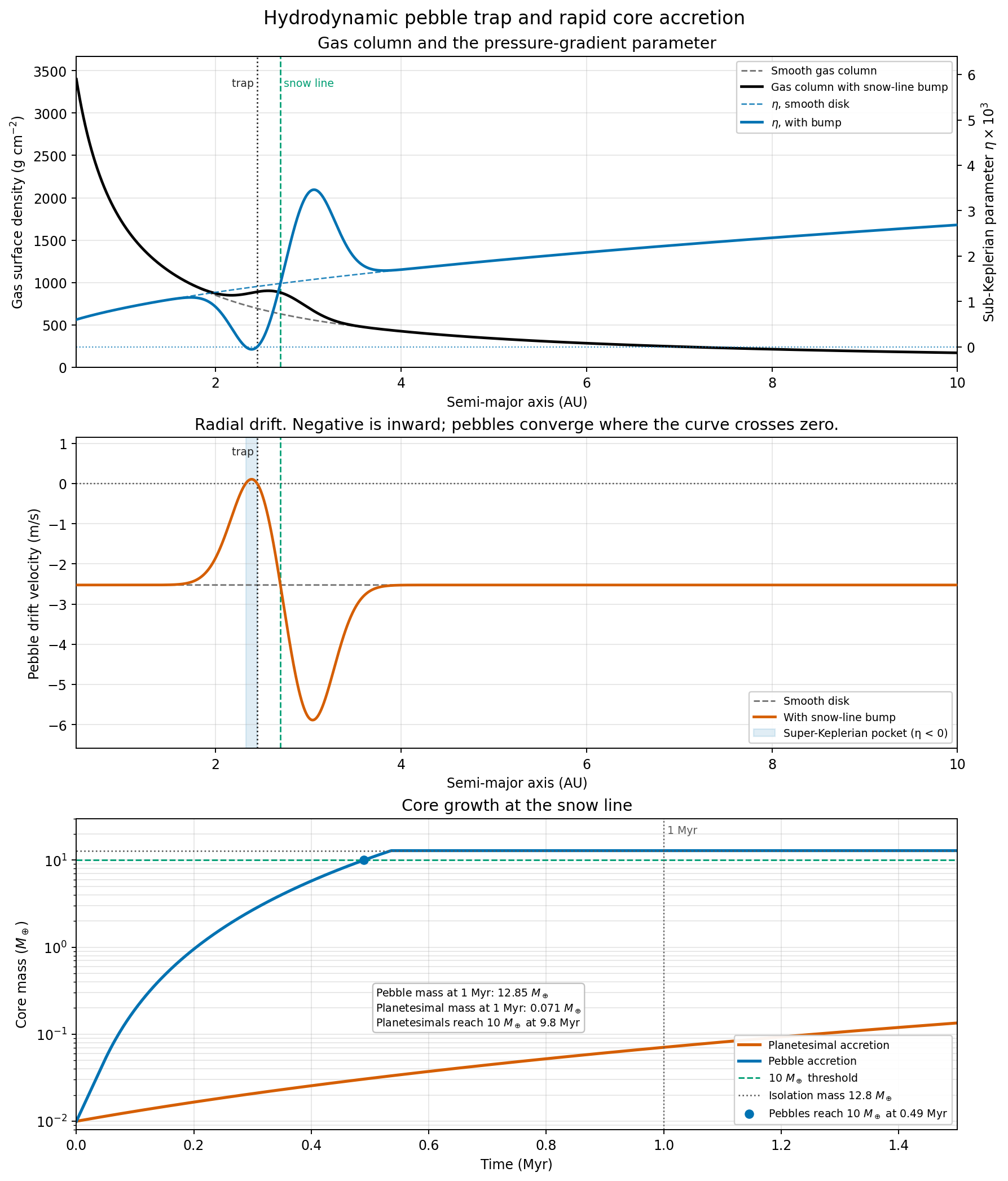
The gas column is a steady power law with a Gaussian enhancement centered on the snow line. With the values used by the module, $\Sigma_0 = 1700\,\mathrm{g\,cm^{-2}}$, $p = -1$, $A = 0.4$, $r_{\mathrm{snow}} = 2.7\,\mathrm{AU}$, and $\Delta r = 0.3\,\mathrm{AU}$:
Temperature follows the Hayashi law, $T = 280\,\mathrm{K}\,(r/1\,\mathrm{AU})^{-1/2}$, at mean molecular weight $\mu = 2.3$ (Hayashi 1981). The aspect ratio is $H/r = c_s/v_K$, with $c_s = \sqrt{k_B T/(\mu m_H)}$. At the embryo it is 0.0431.
Drift and the trap
The pressure index that enters the headwind parameter is the column proxy $\partial\ln(\Sigma c_s^2)/\partial\ln r$, not the hydrostatic midplane slope. The module records both. Hydrostatic midplane pressure, $P_{\mathrm{mid}} = \Sigma c_s \Omega/\sqrt{2\pi}$, stays sub-Keplerian: its minimum $\eta$ is 1.037e-03 at 2.38 AU. The column index does change sign.
Positive $\eta$ is a sub-Keplerian headwind. On the smooth disk, $\eta$ is 8.495e-04 at 1 AU and 1.900e-03 at 5 AU. The radial drift of a single Stokes number is the Nakagawa–Sekiya–Hayashi speed (Nakagawa, Sekiya, and Hayashi 1986; Weidenschilling 1977):
The adopted Stokes number is 0.05. Away from the bump the drift is inward, -2.52 m/s at 1 AU. Across the bump the velocity changes from +0.060 m/s on the inside of the pressure maximum to -0.084 m/s on the outside. The Gaussian crest itself has a vanishing radial derivative, so the background decline of $\Sigma T$ places the pressure maximum on the inner flank, at 2.450 AU. The minimum column $\eta$ is -5.594e-05 at 2.389 AU. Pebbles exterior to the maximum drift inward and pebbles in the shallow super-Keplerian pocket drift outward, so the flux converges at the trap.
Two core-growth channels
Both embryos start at 0.01 Earth masses on the snow line. The pebble accretion radius is $R_{\mathrm{acc}} = (GM/\Omega_K^2)^{1/3}\,\mathrm{St}^{1/3}$. The 2D Hill rate implemented by the module is
While $R_{\mathrm{acc}}$ lies inside the pebble layer, only the fraction $R_{\mathrm{acc}}/H_{\mathrm{peb}}$ of that column is available and the rate is linear in mass. The pebble scale height uses $\alpha_z = 1.0e-04$, which gives $H_{\mathrm{peb}} = 7.785e+08\,\mathrm{m}$ at the embryo. The local pebble column is $Z_{\mathrm{peb}}\Sigma_g = 1.0e-03 \times 881.5\,\mathrm{g\,cm^{-2}}$. Growth stops at the pebble-isolation mass of Lambrechts, Johansen, and Morbidelli (2014),
which is 12.85 Earth masses at this aspect ratio. The pebble core crosses 10 Earth masses at 0.489 Myr and reaches isolation at 0.536 Myr. Its mass at 1 Myr is 12.85 Earth masses, the isolation ceiling.
Planetesimal accretion in the same annulus uses $\Sigma_{\mathrm{pl}} = 30\,\mathrm{g\,cm^{-2}}\,(r/1\,\mathrm{AU})^{-3/2}$, a core density of $2000\,\mathrm{kg\,m^{-3}}$, and a velocity dispersion of 4.3 Hill velocities. The dispersion-dominated rate is
Escape speed and Hill speed both scale as $M^{1/3}$, so the gravitational focusing factor is constant and the rate scales as $M^{2/3}$. That core is only 0.071 Earth masses at 1 Myr. It reaches 10 Earth masses at 9.79 Myr. The two integrations are the quantitative content of the pebble-versus-planetesimal comparison: the pebble channel is finished before 1 Myr, and the planetesimal channel is not.
| Quantity | Value |
|---|---|
| Snow line | 2.7 AU |
| Pressure maximum | 2.450 AU |
| Minimum column η | -5.594e-05 at 2.389 AU |
| Minimum midplane η | 1.037e-03 at 2.38 AU |
| Aspect ratio at the embryo | 0.0431 |
| Pebble isolation mass | 12.85 Earth masses |
| Time to 10 Earth masses, pebbles | 0.489 Myr |
| Time to isolation | 0.536 Myr |
| Pebble mass at 1 Myr | 12.85 Earth masses |
| Planetesimal mass at 1 Myr | 0.071 Earth masses |
| Time to 10 Earth masses, planetesimals | 9.79 Myr |
| Physics checks | 9 passed, 0 failed |
Phase 2 — Grand Tack
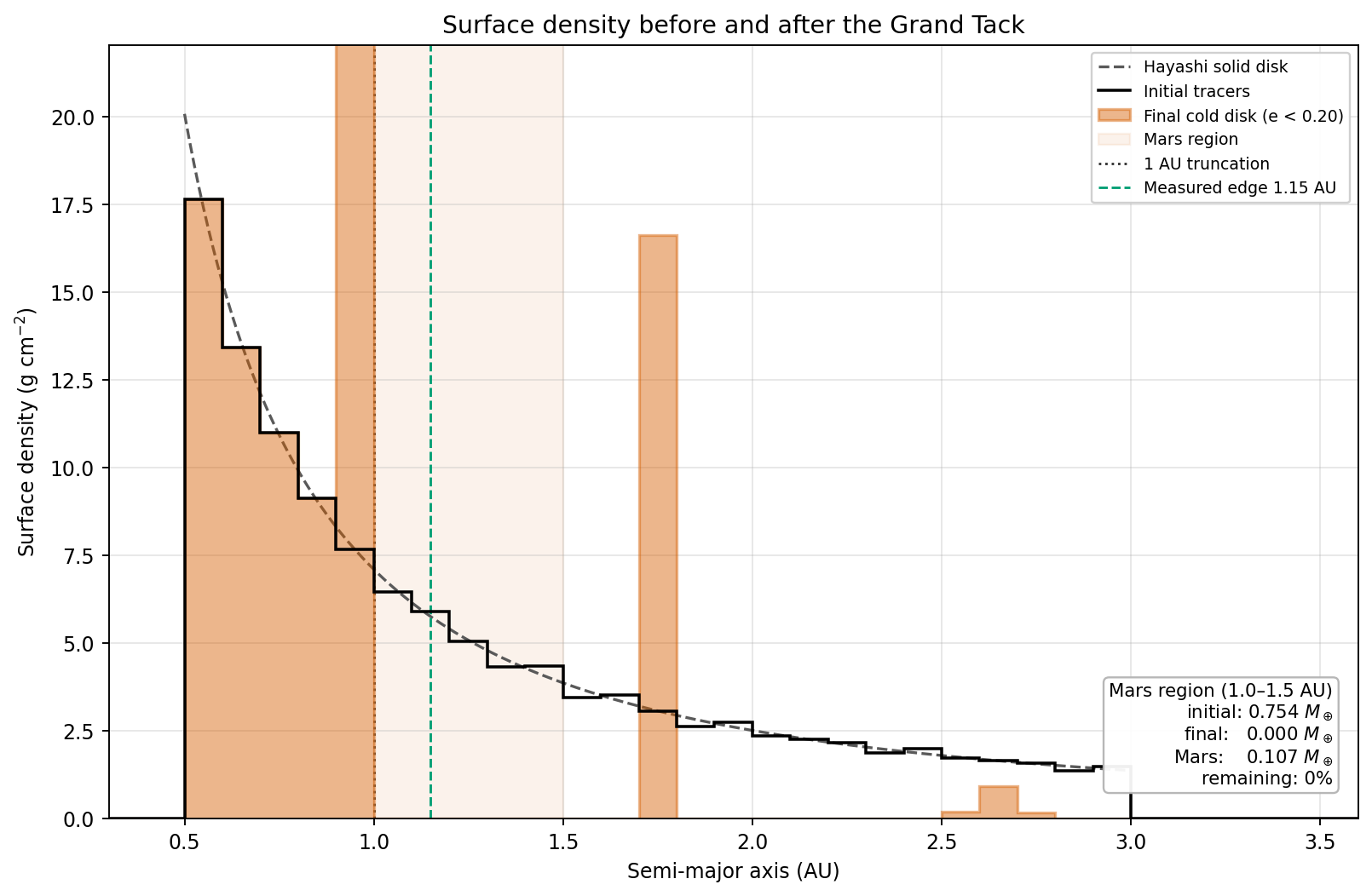
Phase 2 is Grand Tack and the small-Mars paradox. An undepleted solid annulus from 1.0 to 1.5 AU contains 0.754 Earth masses, several times the observed Martian mass of 0.107 Earth masses. The Grand Tack removes that excess by sweeping the giant planets through the terrestrial disk (Walsh et al. 2011). In this framework the migration is prescribed. It is not a radiation-hydrodynamical torque calculation.
Prescribed migration
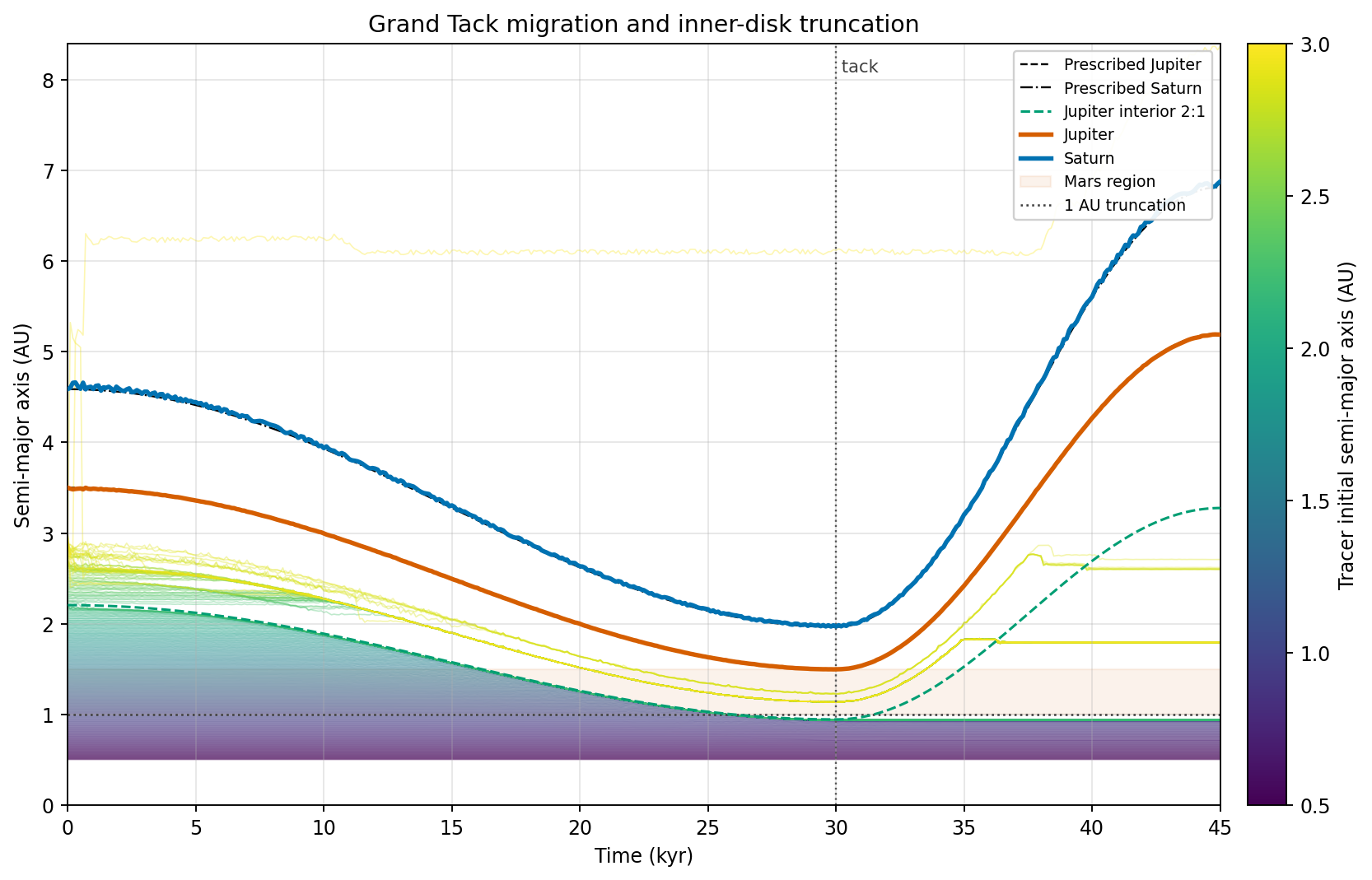
Jupiter's target orbit is a cosine ramp from 3.50 AU to 1.50 AU in 30.0 kyr and back to 5.20 AU in 15.0 kyr. Saturn is held on the exterior 2:3 resonance for the whole track, $P_S/P_J = 3/2$, so
The corresponding axis ratio is 1.3104. The gas disk is not integrated. Its torque is the Papaloizou and Larwood (2000) force used for orbit-averaged migration,
with accelerations $\mathbf{a}\mathrel{+}=\mathbf{v}/(2\tau_a)$ for the semi-major axis, $2(\mathbf{v}\cdot\mathbf{r})\mathbf{r}/(r^2\tau_e)$ for eccentricity, and $2v_z/\tau_i$ for inclination. A negative timescale damps that element. The terrestrial disk is 300 equal-mass tracers of a Hayashi solid surface density, $\Sigma = 7.1\,\mathrm{g\,cm^{-2}}\,(r/1\,\mathrm{AU})^{-3/2}$, from 0.5 to 3.0 AU (Hayashi 1981). Tracer eccentricity and inclination damp on a 400 yr timescale so that sweeping resonances can shepherd solids rather than only scatter them. Cold orbits are those with $e < 0.2$.
The integration uses WHFast in REBOUND with a timestep of 0.02 yr, 300 tracers, and random seed 42 (Rein and Liu 2012; Rein and Tamayo 2015). The wall time recorded for this run is 143.9 s.
Resonance and the mass budget
The integrated tack reaches 1.498 AU, with a minimum semi-major axis of 1.497 AU, against the 1.50 AU target. Jupiter finishes at 5.188 AU and Saturn at 6.876 AU. The final period ratio is 1.526, and the median ratio on the outward leg is 1.517, compared with the resonant value 1.5. The resonant-angle statistic is $R = 0.997$. In the report, $R = 1$ means libration about a fixed angle and $R = 0$ means circulation. Giant-planet eccentricities stay disk-damped: the maxima are 0.029 for Jupiter and 0.063 for Saturn.
The interior 2:1 mean-motion resonance of a Jupiter parked at the tack lies at 0.945 AU. That is the classical truncation radius of the scenario. The cold surface density in this run falls below 30 percent of the initial disk at 1.150 AU. Both radii are reported because they are not the same number. The Mars annulus, initially 0.754 Earth masses, retains 0.000 Earth masses on cold orbits. The inner disk, interior to 1 AU, grows from 0.982 to 2.650 Earth masses of cold solids. Of that growth, 1.668 Earth masses were shepherded from outside 1 AU. The tack therefore does two things at once: it empties the Mars region and it concentrates mass sunward of 1 AU, where Venus and Earth can still accrete.
| Quantity | Value |
|---|---|
| Jupiter, prescribed track | 3.50 → 1.50 → 5.20 AU |
| Jupiter at the tack | 1.498 AU (minimum 1.497 AU) |
| Jupiter and Saturn, final | 5.188 AU and 6.876 AU |
| Final period ratio | 1.526 (median outward 1.517) |
| Resonant-angle statistic | 0.997 |
| Mars annulus, initial → cold | 0.754 → 0.000 Earth masses |
| Inner disk, initial → cold | 0.982 → 2.650 Earth masses |
| Shepherded across 1 AU | 1.668 Earth masses |
| Interior 2:1 at the tack | 0.945 AU |
| Measured cold truncation | 1.150 AU |
| Physics checks | 8 passed, 0 failed |
Phase 3 — Giant impact
Phase 3 is Giant impact, Moon formation, and isotopic homogenization. The calculation has four pieces: the specific energy of a canonical impact, the fluid Roche limit and the bound debris disk, turbulent exchange of $\Delta^{17}\mathrm{O}$ until the disk condenses, and the $^{182}\mathrm{Hf}$–$^{182}\mathrm{W}$ chronometer of core–mantle differentiation.
Specific energy
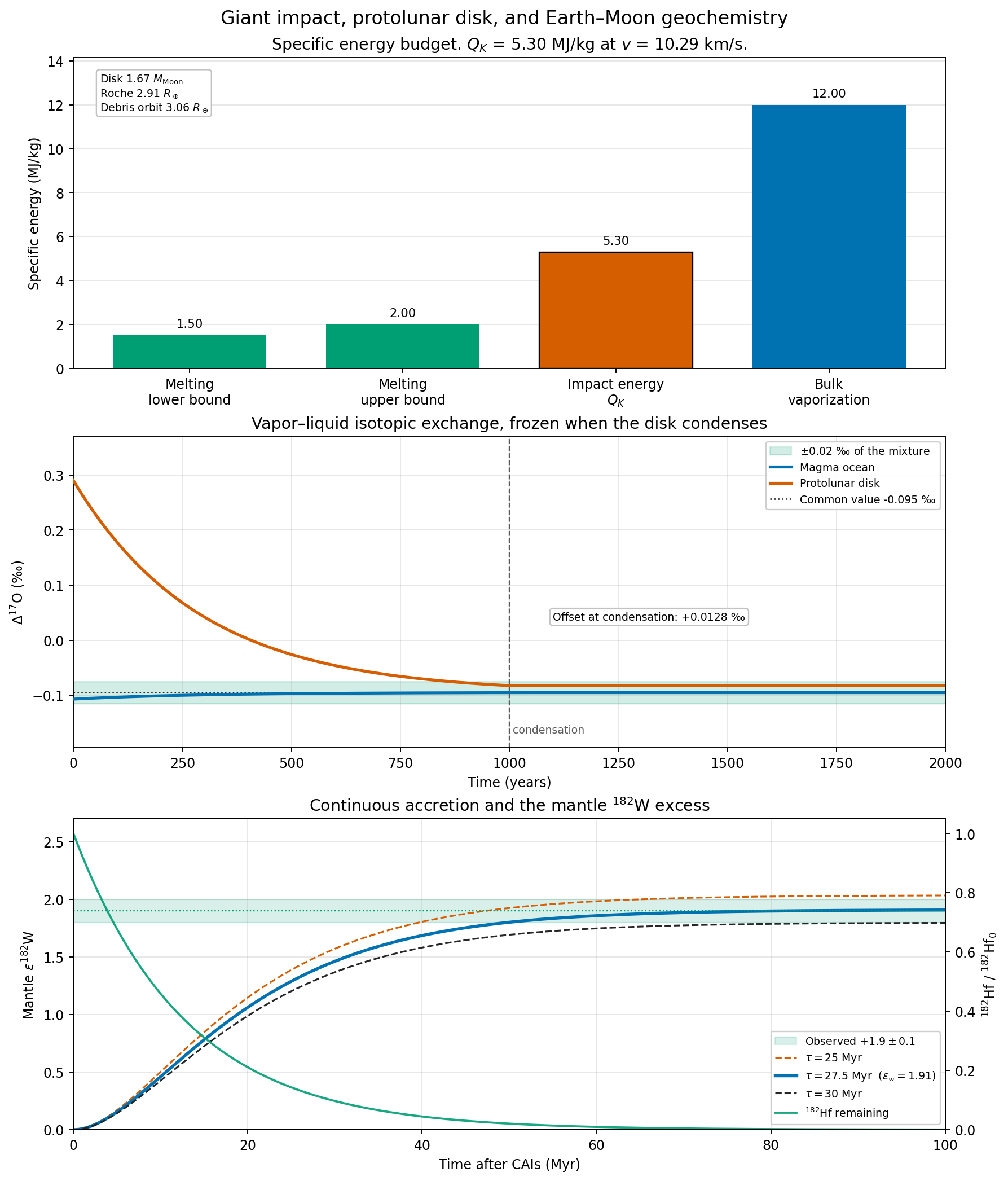
The target is 0.90 Earth masses and Theia is 0.10 Earth masses. The impact angle is 45°, so the impact parameter is $b = \sin\theta = 0.707$. This geometry is the canonical oblique Moon-forming encounter (Canup and Asphaug 2001). The mutual escape speed at contact is 9.36 km/s. The impact speed is 10.29 km/s, or 1.1 times escape. The specific energy used by the module does not contain the impact angle:
The result is 5.295e+06 J/kg. The silicate melting window adopted by the module is $1.5\times 10^{6}$ to $2.0\times 10^{6}$ J/kg, and the bulk vaporization threshold is $1.2\times 10^{7}$ J/kg. $Q_K$ lies above the melting window and below vaporization, so the mantle melt fraction is 100 percent. The physical reading is a global magma ocean under a partial vapor plume, not a wholly vaporized planet.
Protolunar disk
The fluid Roche limit is
With $\rho_{\oplus} = 5513\,\mathrm{kg\,m^{-3}}$ and $\rho_{\mathrm{Moon}} = 3344\,\mathrm{kg\,m^{-3}}$, the limit is 2.906 Earth radii. The verification statement rounds the same limit to 2.91 Earth radii. The disk mass is not taken from a smoothed-particle integration. It is the lunar mass divided by the fraction of a Roche-exterior disk that is assumed to accrete into the Moon,
with $M_{\mathrm{Moon}} = 0.0123$ Earth masses and $\eta_{\mathrm{acc}} = 0.60$. The disk is therefore 1.67 lunar masses, inside the 1.5–2.0 lunar-mass window associated with this impact geometry (Canup 2004). Independently, the impactor arm whose post-shock circularization radius lies outside Roche is integrated as a spherical cap. That arm contains 0.47 lunar masses at 3.06 Earth radii. It is a lower bound. The remainder of the adopted disk is target-mantle ejecta on orbits outside the same limit.
Oxygen isotopes
The endmembers are a proto-Earth at -0.15 ‰ and Theia at +0.40 ‰. The disk is 80 percent Theia silicate. The initial mantle is -0.107 ‰ in 0.655 Earth masses of silicate, and the initial disk is +0.290 ‰ in 0.021 Earth masses. Exchange follows
The mantle equation has the opposite sign and is weighted by $M_{\mathrm{disk}}/M_{\mathrm{mantle}}$, so the mass-weighted composition is constant. That composition is -0.095 ‰. The mixing time is 300 yr. At the condensation time of 1000 yr the difference stops shrinking. The Earth–Moon offset frozen at that time is +0.0128 ‰, inside the module's acceptance window of 0.02 ‰. The small terrestrial–lunar oxygen difference is the isotopic evidence that the two reservoirs were vigorously mixed (Young et al. 2016).
Hafnium–tungsten
Hafnium-182 decays to tungsten-182 with a half-life of 8.9 Myr, so $\lambda = \ln 2/t_{1/2} = 0.07788\,\mathrm{Myr^{-1}}$. The radiogenic yield used here is $q_W = 2.00$, and the silicate Hf/W enrichment is $f_{\mathrm{Hf/W}} = 3.0$. Tungsten partitions into metal at $D_W = 35$. After one equilibration the silicate retains
which the report evaluates as 5.6 percent of the equilibrated tungsten. For exponential accretion with equilibration on arrival, the extinct-hafnium limit is
An e-folding time $\tau = 27.5$ Myr produces $\varepsilon^{182}\mathrm{W} = 1.91$. The module's window of $+1.9 \pm 0.1$ inverts to 30.0, 27.7, and 25.7 Myr for epsilon values of 1.8, 1.9, and 2.0. That is the 25–30 Myr accretion timescale required by the check (Jacobsen 2005; Kleine et al. 2002).
| Quantity | Value |
|---|---|
| Target and Theia | 0.90 and 0.10 Earth masses |
| Impact speed | 10.29 km/s = 1.1 escape |
| Specific energy | 5.295e+06 J/kg |
| Mantle melt fraction | 100 percent |
| Fluid Roche limit | 2.906 Earth radii |
| Protolunar disk | 1.67 lunar masses |
| Impactor arm | 0.47 lunar masses at 3.06 Earth radii |
| Δ17O offset at 1000 yr | +0.0128 ‰ |
| Mass-weighted Δ17O | -0.095 ‰ |
| Nominal ε182W | 1.91 at τ = 27.5 Myr |
| Physics checks | 11 passed, 0 failed |
Phase 4 — Late Veneer
Phase 4 is Volatile delivery, habitability, and geodynamo retention. Two budgets are closed after the magma ocean has crystallized. A carbonaceous late veneer has to supply one terrestrial ocean without exceeding the mantle's highly siderophile element budget, and the outer core has to be able to sustain a magnetic field.
Ocean closure
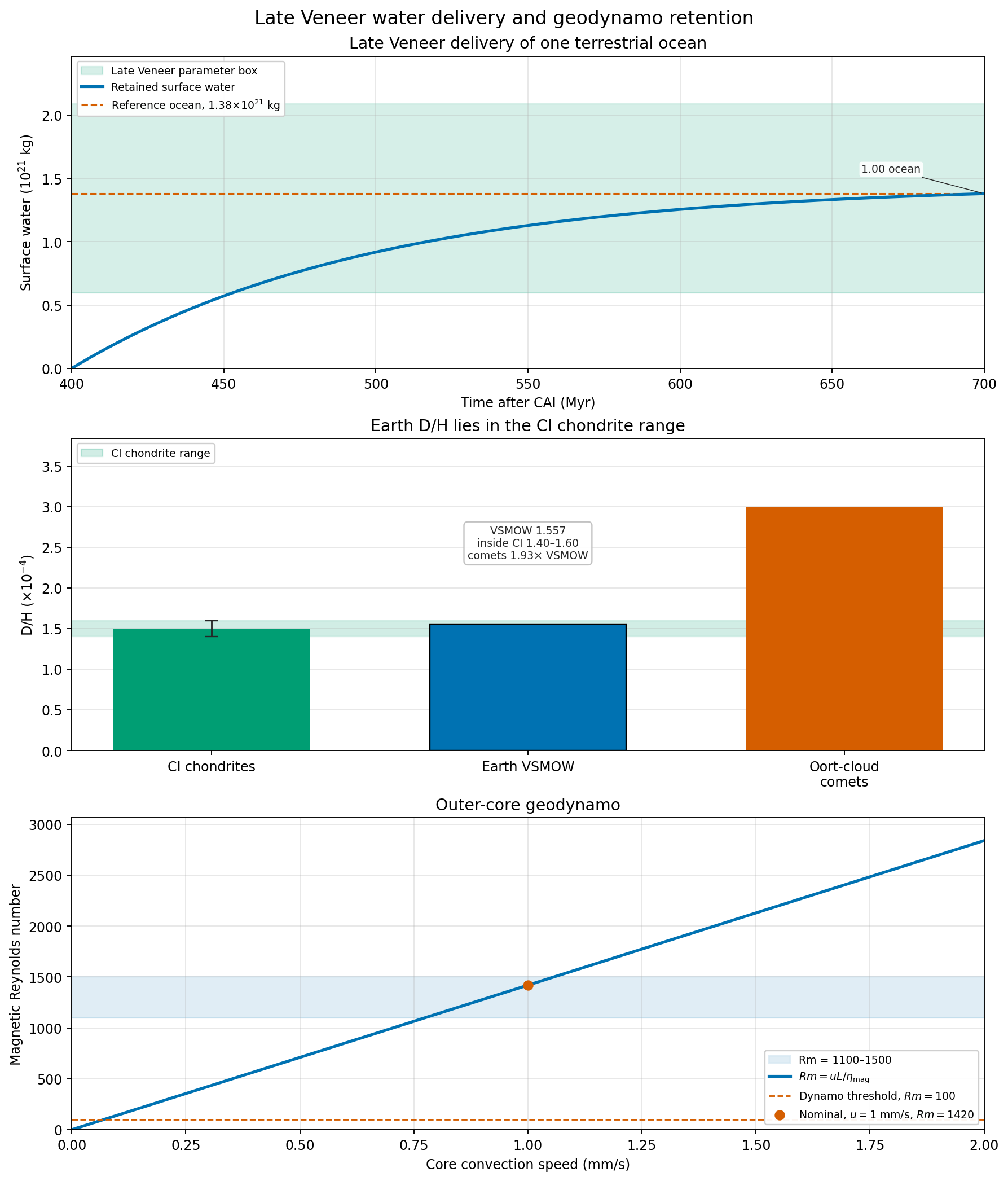
The reference ocean is 1.380e+21 kg. The nominal impactor water fraction is 9 percent, inside the module's CI/CM range of 8–10 percent, and the retention efficiency is 62 percent, inside the adopted range of 50–70 percent. The veneer mass is the mass that delivers exactly one ocean at those nominal values,
so $M_{\mathrm{LV}} = 2.473e+22\,\mathrm{kg}$, or 0.414 percent of an Earth mass. The module tests that mass against its highly siderophile element window, 0.25–0.50 percent of an Earth mass ($1.50\times 10^{22}$ to $2.50\times 10^{22}$ kg), the mantle budget reviewed by Walker (2009). The derived veneer sits inside that window. The delivered reservoir is 1.380000e+21 kg, or 1.0000 oceans. The corners of the parameter box, from the low water fraction and retention at the low veneer mass to the high values at the high veneer mass, span 5.972e+20 to 2.090e+21 kg and still bracket the reference ocean. Delivery is spread from 400 to 700 Myr. The impactor flux declines exponentially with an e-folding time of 100 Myr, and the integral is normalized to one ocean.
Hydrogen isotopes
The D/H comparison uses laboratory reservoir values rather than a dynamical source model. Vienna Standard Mean Ocean Water is 1.557e-04. The CI chondrite interval is 1.400e-04 to 1.600e-04, and the offset of VSMOW from the CI midpoint is 3.7 percent. Oort-cloud comets are 3.000e-04, a factor of 1.93 above VSMOW. The ocean therefore matches carbonaceous asteroids and does not match cometary ice (Alexander et al. 2012).
Geodynamo
The convective shell is the outer core between an inner-core boundary at 1220 km and a core–mantle boundary at 3480 km. Its thickness is $L = 2.260e+06\,\mathrm{m}$. With a liquid-iron conductivity $\sigma = 5.0e+05\,\mathrm{S\,m^{-1}}$, the magnetic diffusivity is
which equals 1.5915 m$^{2}$/s. At a convective speed $u_{\mathrm{conv}} = 1.0e-03\,\mathrm{m\,s^{-1}}$,
the magnetic Reynolds number is 1420.0. The module adopts $\mathrm{Rm} = 100$ as a conservative threshold for a self-sustaining dynamo and also requires the nominal value to lie between 1100 and 1500. That Reynolds number is the controlling parameter of a planetary dynamo (Jones 2011). Both conditions hold. This is a Reynolds-number budget for a uniform conductivity and a single speed, not a three-dimensional magnetohydrodynamic simulation.
| Quantity | Value |
|---|---|
| Reference ocean | 1.380e+21 kg |
| Water fraction and retention | 9 percent and 62 percent |
| Late-veneer mass | 2.473e+22 kg (0.414 percent of an Earth mass) |
| Delivered water | 1.380000e+21 kg (1.0000 oceans) |
| Parameter box | 5.972e+20 to 2.090e+21 kg |
| VSMOW D/H | 1.557e-04 |
| CI chondrite D/H | 1.400e-04 to 1.600e-04 |
| Cometary D/H | 3.000e-04 (1.93 times VSMOW) |
| Magnetic diffusivity | 1.5915 m²/s |
| Magnetic Reynolds number | 1420.0 (threshold 100) |
| Physics checks | 10 passed, 0 failed |
Master benchmark
The table below is the union of the physics checks printed at the end of the four phase reports. The status and the reported value are copied from those lines. The master summary's own total is 38 passed and 0 failed.
| # | Phase | Check | Value reported by the module | Status |
|---|---|---|---|---|
| 1 | 1 — Pebble accretion | Smooth disk is sub-Keplerian | η(1 AU) = 8.495e-04, η(5 AU) = 1.900e-03 | PASS |
| 2 | 1 — Pebble accretion | Snow-line bump drives η through zero | minimum η = -5.594e-05 at 2.389 AU | PASS |
| 3 | 1 — Pebble accretion | The reversal is shallow | minimum η = -5.594e-05 | PASS |
| 4 | 1 — Pebble accretion | Pebbles converge near the snow line | pressure maximum at 2.450 AU, v_r(inside) = +0.060 m/s, v_r(outside) = -0.084 m/s | PASS |
| 5 | 1 — Pebble accretion | Drift is inward away from the bump | v_r(1 AU) = -2.52 m/s, v_r(5 AU) = -2.52 m/s | PASS |
| 6 | 1 — Pebble accretion | Pebble accretion crosses 10 M_earth before 1 Myr | t(10 M_earth) = 0.489 Myr | PASS |
| 7 | 1 — Pebble accretion | Pebble core at 1 Myr is 10–15 M_earth | M(1 Myr) = 12.85 M_earth, isolation mass = 12.85 M_earth | PASS |
| 8 | 1 — Pebble accretion | Planetesimal accretion misses 10 M_earth inside 1 Myr | M(1 Myr) = 0.071 M_earth | PASS |
| 9 | 1 — Pebble accretion | Planetesimal core reaches 10 M_earth on a ~10 Myr timescale | t(10 M_earth) = 9.79 Myr | PASS |
| 10 | 2 — Grand Tack | Jupiter reaches the tack | a(t_tack) = 1.498 AU, min a = 1.497 AU | PASS |
| 11 | 2 — Grand Tack | Jupiter ends near 5.2 AU | final a = 5.188 AU | PASS |
| 12 | 2 — Grand Tack | Saturn ends in the 2:3 | final P_S/P_J = 1.526 | PASS |
| 13 | 2 — Grand Tack | 2:3 holds on the way out | median outward P_S/P_J = 1.517 | PASS |
| 14 | 2 — Grand Tack | Giant orbits stay disk-damped | max e_J = 0.029, max e_S = 0.063 | PASS |
| 15 | 2 — Grand Tack | Mars region is depleted | cold Mars-zone mass 0.000 / 0.754 M_earth (remaining 0.00) | PASS |
| 16 | 2 — Grand Tack | Inner disk outweighs the Mars region | inner 2.650 vs Mars 0.000 M_earth | PASS |
| 17 | 2 — Grand Tack | Cold disk truncates near 1 AU | measured truncation at 1.15 AU | PASS |
| 18 | 3 — Giant impact | Impact speed is 1.1 times mutual escape | v_imp = 10.29 km/s = 1.100 v_esc | PASS |
| 19 | 3 — Giant impact | Specific energy exceeds complete silicate melting | Q_K = 5.295e+06 J/kg, melting threshold = 1.5e+06–2.0e+06 J/kg, melt fraction = 100% | PASS |
| 20 | 3 — Giant impact | Impact energy stays below bulk silicate vaporization | Q_K = 5.295e+06 J/kg, vaporization threshold = 1.2e+07 J/kg | PASS |
| 21 | 3 — Giant impact | Protolunar disk is 1.5–2.0 lunar masses | M_disk = 1.67 M_moon | PASS |
| 22 | 3 — Giant impact | Fluid Roche limit is about 2.9 Earth radii | a_Roche = 2.906 R_earth | PASS |
| 23 | 3 — Giant impact | Bound debris circularizes outside the Roche limit | impactor-arm circularization radius = 3.06 R_earth, Roche = 2.91 R_earth | PASS |
| 24 | 3 — Giant impact | Earth–Moon Δ¹⁷O offset is at most 0.02 ‰ at condensation | |Δ_disk − Δ_mantle|(1000 yr) = 0.0128 ‰ | PASS |
| 25 | 3 — Giant impact | Exchange actually moves the two reservoirs together | initial disk +0.290 ‰, initial mantle -0.107 ‰, common value -0.095 ‰ | PASS |
| 26 | 3 — Giant impact | Nominal accretion timescale reproduces ε¹⁸²W = +1.9 ± 0.1 | τ = 27.5 Myr gives ε = 1.91 | PASS |
| 27 | 3 — Giant impact | Observed +1.9 ± 0.1 inverts to a 25–30 Myr accretion time | ε = 1.8, 1.9, 2.0 map to τ = 30.0, 27.7, 25.7 Myr | PASS |
| 28 | 3 — Giant impact | Magma-ocean metal sequesters most of the tungsten | D_W = 35, silicate retains 5.6% of W | PASS |
| 29 | 4 — Late Veneer | Chondritic water fraction is 8–10% | w_H2O = 9% | PASS |
| 30 | 4 — Late Veneer | Retention efficiency is 50–70% | η_retention = 62% | PASS |
| 31 | 4 — Late Veneer | Late Veneer mass matches the HSE mantle budget | M_LV = 2.473e+22 kg = 0.414% M_earth | PASS |
| 32 | 4 — Late Veneer | Retained water equals one terrestrial ocean | delivered 1.380000e+21 kg, reference 1.380000e+21 kg | PASS |
| 33 | 4 — Late Veneer | The reference ocean lies inside the Late Veneer parameter box | box 5.972e+20–2.090e+21 kg | PASS |
| 34 | 4 — Late Veneer | Earth D/H matches carbonaceous chondrites | VSMOW 1.557e-04, CI 1.400e-04–1.600e-04, offset from the CI midpoint 3.7% | PASS |
| 35 | 4 — Late Veneer | Cometary water is isotopically distinct from the oceans | comets 3.000e-04 = 1.93 × VSMOW | PASS |
| 36 | 4 — Late Veneer | Magnetic diffusivity is about 1.59 m²/s | η_mag = 1.5915 m²/s | PASS |
| 37 | 4 — Late Veneer | Magnetic Reynolds number exceeds the dynamo threshold | Rm = 1420, threshold 100 | PASS |
| 38 | 4 — Late Veneer | Nominal Reynolds number is 1100–1500 | Rm(u = 1 mm/s) = 1420 | PASS |
Discussion
Read in chronicle order, the four results describe a habitable endpoint that is reached for specific, stated reasons. The Jupiter core can be in place before 1 Myr because drift reverses at 2.450 AU and the isolation mass at this aspect ratio is only 12.85 Earth masses. The same solid annulus cannot do that job by planetesimal accretion on a disk lifetime. The small mass of Mars is then a consequence of the tack: the cold reservoir between 1 and 1.5 AU is removed, from 0.754 Earth masses to 0.000, while 1.668 Earth masses are added to the inner disk. The Moon-forming impact that follows is energetic enough to melt the mantle and to mix oxygen isotopes, and it is not energetic enough to vaporize the bulk silicate. The tungsten excess dates the main phase of accretion to about 27.5 Myr, which sits between the impact window of the chronicle and the much later veneer. The veneer that arrives after 400 Myr is small in mass, 0.414 percent of an Earth mass, but at a chondritic water fraction and a retention efficiency of 62 percent it is exactly one ocean. Its D/H ratio selects asteroids over comets. The same planet can keep the field that helps that ocean persist: $\mathrm{Rm} = 1420.0$.
The limitations are part of the result. The pebble disk is steady, so the trap is a property of the adopted column, not of a viscously evolving nebula. The sign change in $\eta$ belongs to $\partial\ln(\Sigma c_s^2)/\partial\ln r$. The hydrostatic midplane pressure of this bump does not reverse, and the report says so. Saturn is placed in the 2:3 at the start of the tack rather than captured into it, and the terrestrial bodies are massless tracers with an aerodynamic damping time. The measured cold truncation, 1.150 AU, is close to 1 AU but is not identical to the interior 2:1 at 0.945 AU. The protolunar disk mass is $M_{\mathrm{Moon}}/\eta_{\mathrm{acc}}$, and the impactor arm is only the geometric lower bound of 0.47 lunar masses. The oxygen endmembers, the mixing time, and the condensation time are inputs. The late-veneer mass is derived by closing one ocean and is then tested against the siderophile window, which is a consistency test of the adopted ranges. The dynamo statement is a magnetic Reynolds number.
Within those definitions the suite is internally closed. Every acceptance window written into the four reports is satisfied, and the master summary records 38 passed checks and 0 failed checks.
Reproducibility
From the repository root, the four modules and the master runner rewrite the reports that this document quotes:
python -m modules.module1_pebble_accretion.pebble_accretion_simpython -m modules.module2_grand_tack.grand_tack_simpython -m modules.module3_giant_impact.giant_impact_simpython -m modules.module4_late_veneer.late_veneer_simpython run_all_ssgf.pypython docs/generate_whitepaper.py
The Grand Tack entry above is the long integration. In the run quoted here it used integrator whfast, a timestep of 0.02 yr, 300 tracers, seed 42, and 143.9 s of wall time. The figures are the PNGs already written to output/ by the plotting scripts in visualization/. This generator does not redraw them. Regenerating the whitepaper overwrites docs/SSGF_Executive_Scientific_Whitepaper.md and docs/SSGF_Scientific_Whitepaper.html.
References
- Alexander, C. M. O'D., Bowden, R., Fogel, M. L., Howard, K. T., Herd, C. D. K., and Nittler, L. R. (2012). The provenances of asteroids, and their contributions to the volatile inventories of the terrestrial planets. Science, 337, 721–723.
- Canup, R. M. (2004). Simulations of a late lunar-forming impact. Icarus, 168, 433–456.
- Canup, R. M., and Asphaug, E. (2001). Origin of the Moon in a giant impact near the end of the Earth's formation. Nature, 412, 708–712.
- Hayashi, C. (1981). Structure of the solar nebula, growth and decay of magnetic fields and effects of magnetic and turbulent viscosities on the nebula. Progress of Theoretical Physics Supplement, 70, 35–53.
- Jacobsen, S. B. (2005). The Hf-W isotopic system and the origin of the Earth and Moon. Annual Review of Earth and Planetary Sciences, 33, 531–570.
- Jones, C. A. (2011). Planetary magnetic fields and fluid dynamos. Annual Review of Fluid Mechanics, 43, 583–614.
- Kleine, T., Münker, C., Mezger, K., and Palme, H. (2002). Rapid accretion and early core formation on asteroids and the terrestrial planets from Hf–W chronometry. Nature, 418, 952–955.
- Lambrechts, M., and Johansen, A. (2012). Rapid growth of gas-giant cores by pebble accretion. Astronomy & Astrophysics, 544, A32.
- Lambrechts, M., Johansen, A., and Morbidelli, A. (2014). Separating gas-giant and ice-giant planets by halting pebble accretion. Astronomy & Astrophysics, 572, A35.
- Nakagawa, Y., Sekiya, M., and Hayashi, C. (1986). Settling and growth of dust particles in a laminar phase of a low-mass solar nebula. Icarus, 67, 375–390.
- Papaloizou, J. C. B., and Larwood, J. D. (2000). On the orbital evolution and growth of protoplanets embedded in a gaseous disc. Monthly Notices of the Royal Astronomical Society, 315, 823–833.
- Rein, H., and Liu, S.-F. (2012). REBOUND: an open-source multi-purpose N-body code for collisional dynamics. Astronomy & Astrophysics, 537, A128.
- Rein, H., and Tamayo, D. (2015). WHFast: a fast and unbiased implementation of a symplectic Wisdom–Holman integrator for long-term gravitational simulations. Monthly Notices of the Royal Astronomical Society, 452, 376–388.
- Walker, R. J. (2009). Highly siderophile elements in the Earth, Moon and Mars: update and implications for planetary accretion and differentiation. Chemie der Erde, 69, 101–125.
- Walsh, K. J., Morbidelli, A., Raymond, S. N., O'Brien, D. P., and Mandell, A. M. (2011). A low mass for Mars from Jupiter's early gas-driven migration. Nature, 475, 206–209.
- Weidenschilling, S. J. (1977). Aerodynamics of solid bodies in the solar nebula. Monthly Notices of the Royal Astronomical Society, 180, 57–70.
- Young, E. D., Kohl, I. E., Warren, P. H., Rubie, D. C., Jacobson, S. A., and Morbidelli, A. (2016). Oxygen isotopic evidence for vigorous mixing during the Moon-forming giant impact. Science, 351, 493–496.